Focus on biodiversity
January 19, 2024
Today seems like another world compared to when the original Grasstrees website was launched in 2014. It was prior to the drought years of 2017 – 2019; prior to the bushfire of 11 November 2019 which left 90% of the reserve in cinders; prior to COVID and the La Nina wet years. Another short but deep dry spell from May to November 2023 has also come and gone.
Much has changed. Sadly, the most notable changes have occurred in fewer sightings of animal and plant species. In 2011, twenty Glossy Black Cockatoos descended on a mature Allocasuarina torulosa near Ben’s Lookout, and that was the last time the species was sighted at Grasstrees. Similarly, Turquoise Parrots were regular visitors along the entrance road, but not one has been sighted since before the drought.
Sugar Glider (we think) tails could be found easily on the property prior to the drought. Taken as a sign of predation (perhaps by Barking Owls?), it also provided evidence of their presence. But no more. And the list goes on: microbat numbers appear to be well down; mature (as in big and scary) huntsman spiders have returned this summer for the first time since the bushfire, but sightings are few; bird numbers in general appear to be lower, as do butterfly and frog sightings.
Disheartening is an understatement. However, this sad situation has sharpened the Grasstrees focus on supporting and conserving its biodiversity.
As part of that process, a new domain name has been registered, and the Stay on Bolivia Hill website has been refreshed and published at this new domain. A feature of the new website is making available ‘the lists’ of observations and identifications (thus far) of plant and animal species. Invoking the spirit of scientific collaboration, photos of many species that remain unidentified are included on ‘the lists’ in the hope that readers can assist with identification.
So, dear readers, if a listing or ID is incorrect in your opinion, please let us know. We have a continent to learn ……….
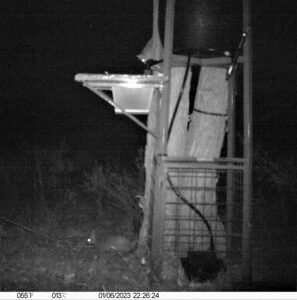 we thought it would be unlikely that we would see any koalas taking advantage of free drinks in our lifetime. But we did think that other locals would appreciate the convenience, and that would be a good thing, especially during dry times. These two brush-tail possums were quick to take up the offer. Their night-time manoeuvres were captured on the movement sensor camera we have installed nearby. Gotcha guys!
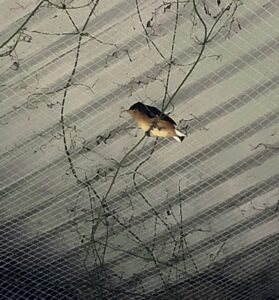 The nest was well hidden at about 2.5m above ground, deep within the climbing tangles, and blocked from view by the hundreds of seeding flowerheads which give this climber its common names of ‘old man’s beard’ or ‘grandpa’s whiskers’. In Spring 2022, we were very pleased to see the nesting couple had returned and were building again. For weeks the parents happily ignored us as we sat at the table. We enjoyed many close encounters of the feathered kind, especially after the chicks hatched. We timed relays of food deliveries at between 90 seconds and 3 minutes. On Tuesday 25 October, as we sat down for our lunch break, we noticed a change. A bub Spinebill had emerged and was sitting quietly overhead. But the food relays continued, and we were lucky enough to capture these 2 very short videos:
 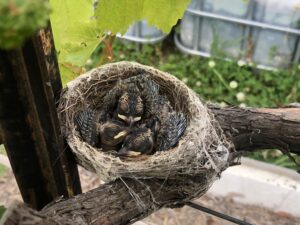 And fewer bugs and grubs mean less tucker for hungry babies. All of which probably helps to explain why it took four attempts by our resident Willie Wagtail parents to complete a successful nesting cycle. After the first three nests and eggs were abandoned, it is just a week since three chicks finally left their nest in the grapevine.
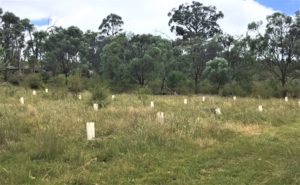 A wet winter was beneficial after the first planting in April, and those 80 trees appear to have become established. However, cooler and dryer conditions in recent weeks have had a negative impact, especially on the second batch of 160 trees. Fortunately, we are able to monitor the trees easily as our daily walk to the Back Creek takes us through the habitat area. Supplementary watering has been undertaken when deemed necessary. A few plants have fallen victim to local macropods in transit, but total losses to date are fewer than 20.
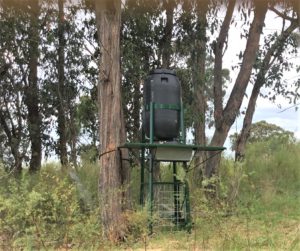 We were able to install it in a patch of mature Eucalypts on the fringe of the newly-planted trees. So, the drinks are on us! A motion sensor camera is being installed this week, and that will tell us who is taking advantage.
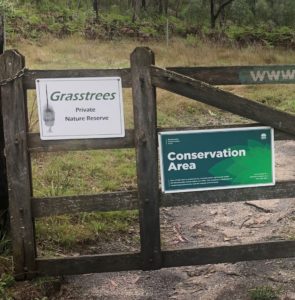 Signing the agreement was the culmination of over 12 months’ collaboration with BCT Senior Landholder Support Officer Anthony Collins. The agreement contains a management plan, recommended management actions, and spells out restrictions on use of the Conservation Area.
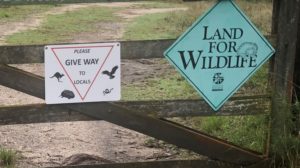 The process of working towards the agreement has clarified our thinking about exactly what we hope to achieve here. It has meant letting go of some ideas and being open to others we had not considered previously. The end result is that we are now firmly entrenched in regenerating and conserving our tiny piece of Planet Earth; and we have some new options available to help us get on with it.
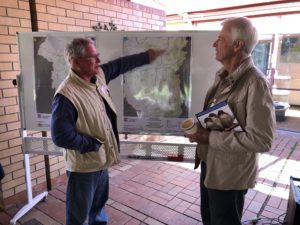 great opportunity to learn more about these threatened species. We have had many sightings of Little Eagles at Grasstrees, and some ‘maybe’ sightings of Square Tailed Kites. Having a chat with Dr Stephen Debus (legend) about our sightings was a highlight. Steve has been studying Australian Raptors for over 40 years, and has described the Little Eagle as “ a spectacular hunter and flier having an exuberant courtship display and voice”.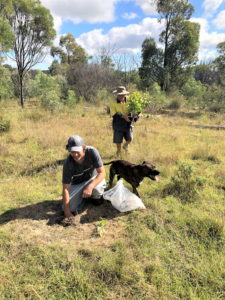
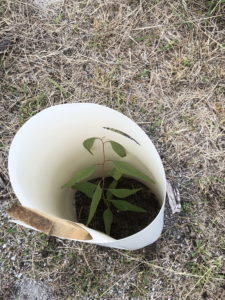 So, we submitted our EOI and were told to be ready for an autumn planting. Not all our 240 seedlings are ready for planting just yet; some will have to wait for spring. But it was great to make a start with 40 E. blakelyi and 40 E. melliodora plants now in the ground and looking good! The Cool Country Koala Project will see thousands of koala-friendly trees planted across the Northern Tablelands in a bid to provide habitat and food.
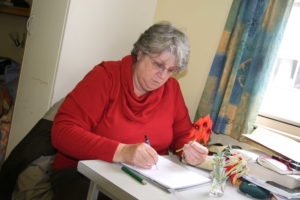 Well, we don’t need friends when it comes to lemons because we have a very productive tree; but we certainly appreciate our very talented friends who help us in so many ways to make Grasstrees Private Nature Reserve a very special place. This is our friend and botanical artist Glenyth McKenzie, seen here sketching Swainsona formosa [Alice Springs July 2010].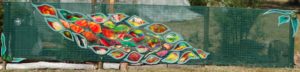
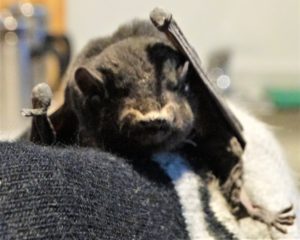 but we were really pleased to discover this microbat had landed in the firebox.
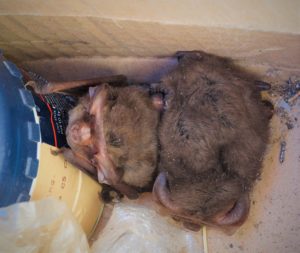 most unexpected place. We think these two belong to a species of long-eared bat. It seems they like cuddling in under the old rags in my paint box.
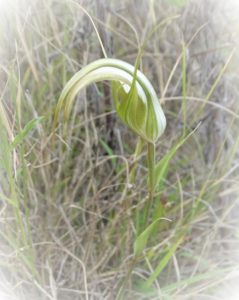 This is Pterostylis revoluta; one of four Pterostylis species which have been identified in Grasstrees Private Nature Reserve (GPNR). Commonly known as the Autumn Greenhood, it is always a delight to come across a group of these graceful terrestrial orchids. Typically, Greenhood orchids go through a dormant stage, surviving underground as a tuber. And there they will wait until conditions above ground are favourable. But who knows where those tubers are waiting, unseen? Maybe in proximity to plants seen in a previous season, but maybe not even close to where you spotted them last time. For most of the year, there is no evidence above ground of what lies beneath. So, you can never be sure exactly where one or a group of these fascinating plants will emerge. And that’s what makes spotting them such a wonderful surprise!
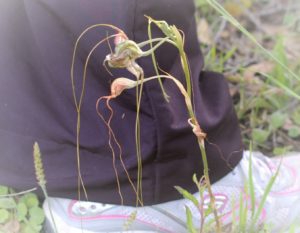 and this absolute stunner P. woollsii (long-tailed greenhood). It is always a cause of great excitement when a P. woollsii shoot emerges from the ground in the warmer months. As well as the Pterostylis orchids, we have identified six other species of terrestrial orchids in GPNR, including the common but still gorgeous Waxlip Orchid (Caladenia major).